
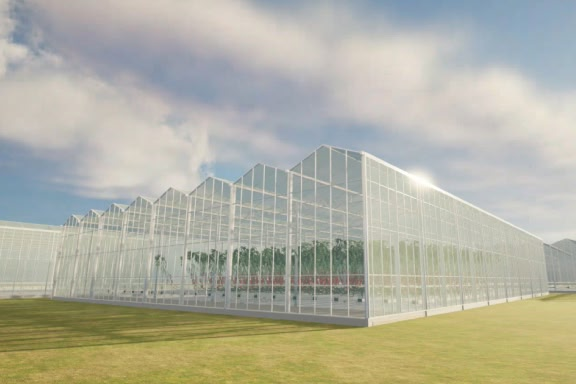
The service offers a cutting-edge Virtual Greenhouse Simulation Service—a photorealistic digital environment designed to accelerate the development and testing of robotics for greenhouse applications. This configurable virtual greenhouse replicates real-world conditions, including size, lighting (both natural and supplementary), and row spacing, enabling clients to tailor simulations to their specific crop production setups.
The implementation focuses on existing crop models, combining realistic plant parameters with accurate physical interactions. This enables robot models to be tested in scenarios such as harvesting and de-leafing without the costs or risks associated with physical trials. Integration with ROS2 allows seamless testing of AI detection systems and complete robotic workflows within the simulation.
How can the service help you?
To train and test a detection network, a big annotated dataset with high variability is required. Using the virtual environment, it is easy to create different circumstances to generate photorealistic synthetic data to train or test AI detection networks. Additionally, by incorporating the customer's robot into the environment, it becomes possible to run unlimited test repetitions in the greenhouse—something that isn't feasible in real-life scenarios, where, for example, a specific fruit can only be harvested once.
By using this virtual greenhouse, clients can reduce development time, improve robotic performance, and experiment safely with crop management strategies—enabling efficiency and innovation in controlled-environment agriculture.
How the service will be delivered
The service operates in a fully digital environment, making it independent of any physical location. The outcome of the tests depends on customer requirements and therefore needs to be discussed upfront. The outcome could consist of an annotated dataset, performance evaluation of an AI detection network or performance of a robot in the greenhouse.
Service customisation
The virtual testing environment consists of standard configurable elements. Therefore, there are ample opportunities for customers to design the environment according to the required situation. As the environment does not include all robots by default, customers' robots should be implemented if it is required to test the interaction of the robots in the environment itself.