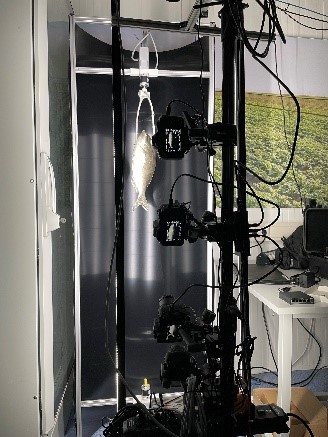
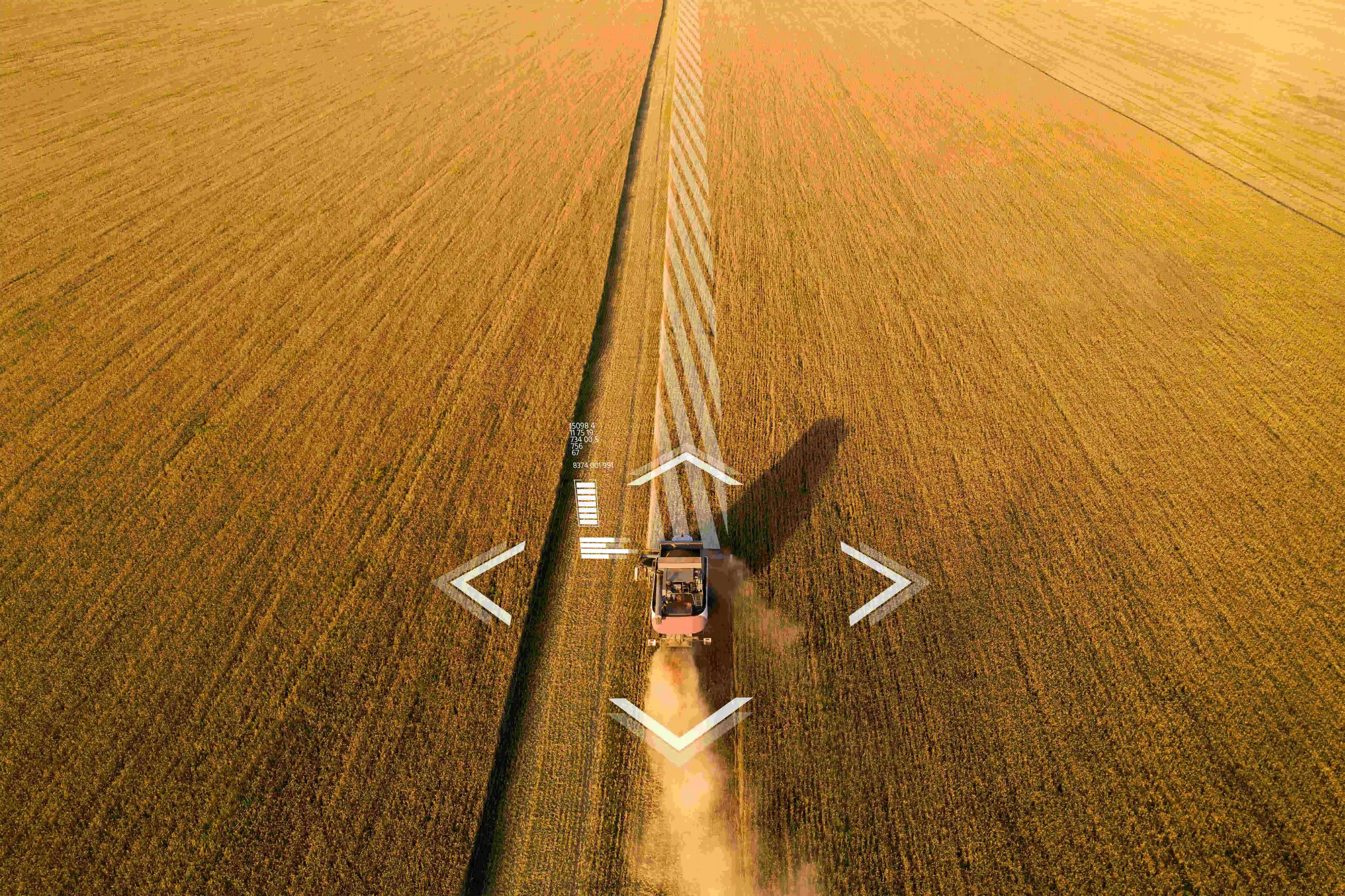
The facility includes a mechanical workshop, an extensive range of robot platforms and hardware (e.g., sensors) and a 200 m³ motion capture volume. A close collaboration with Università degli Studi di Milano allows AIRLab to test robot systems for agricultural applications in fields, orchards and greenhouses.
The cluster comprises 4 servers with 24 GPUs overall and a NAS. It is installed in a climate-controlled server room; power is distributed via industrial UPS units.
In the mechanisation and automation workshop of the living lab Agrifood Technology of ILVO, technological prototypes for the agrifood sector are ideated, designed, developed, and tested in controlled conditions. An iterative development process is used; this is an agile approach with subsequent multiple cycles of (re)design and testing. Machines are designed in CAD software (Solidworks). For reverse engineering, a 3D scanner and post-processing software are used. For metalworking, lathes, milling machines, bending machines, and welding machines are available.
ILVO's Spray Tech Lab is one of the few accredited spray technology laboratories in the world specialising in the characterisation of sprayers and nozzles. In addition to accredited testing, the laboratory has the experimental facilities to develop spray application systems and evaluate them under field or laboratory conditions. Current research priorities include greenhouse and open field spray applications, spray drift, nozzle characterisation, orchard spray applications, and biological crop protection applications.
The ILVO Hyperspectral Technology Facility enables advanced applications in agri-food processing, such as quality control, defect detection, grading, and sorting of (raw) products. By comparing spectral and spatial data to reference measurements, we build chemometric models capable of estimating product parameters in real time. The facility hosts a range of hyperspectral and multispectral devices, including spectrometers with customisable probes, hyperspectral cameras, and FTNIRS systems suited for both solid and liquid samples.
Located within a network of real-world testing and validation environments, this facility facilitates collaboration between technological SMEs and agricultural experts. It serves as a platform for developing cutting-edge solutions tailored to address specific challenges in the sector. The space supports businesses by bridging the gap with expert advice, specialist training, and networking opportunities, ensuring innovative ideas are rigorously tested and refined.
INRIA has access to a 100 m x 100 m reconfigurable outdoor facility located at AzurArena in Antibes, ideal for conducting experiments involving Autonomous Vehicles (AVs), Autonomous Ground Robots (AGRs), and Unmanned Aerial Vehicles (UAVs). The site can be equipped with a 4G/5G communication network, enabling real-time connectivity and coordination across multiple robotic platforms. Its open and adaptable layout makes it suitable for both individual and collaborative autonomous system testing.