Purpose & Scope
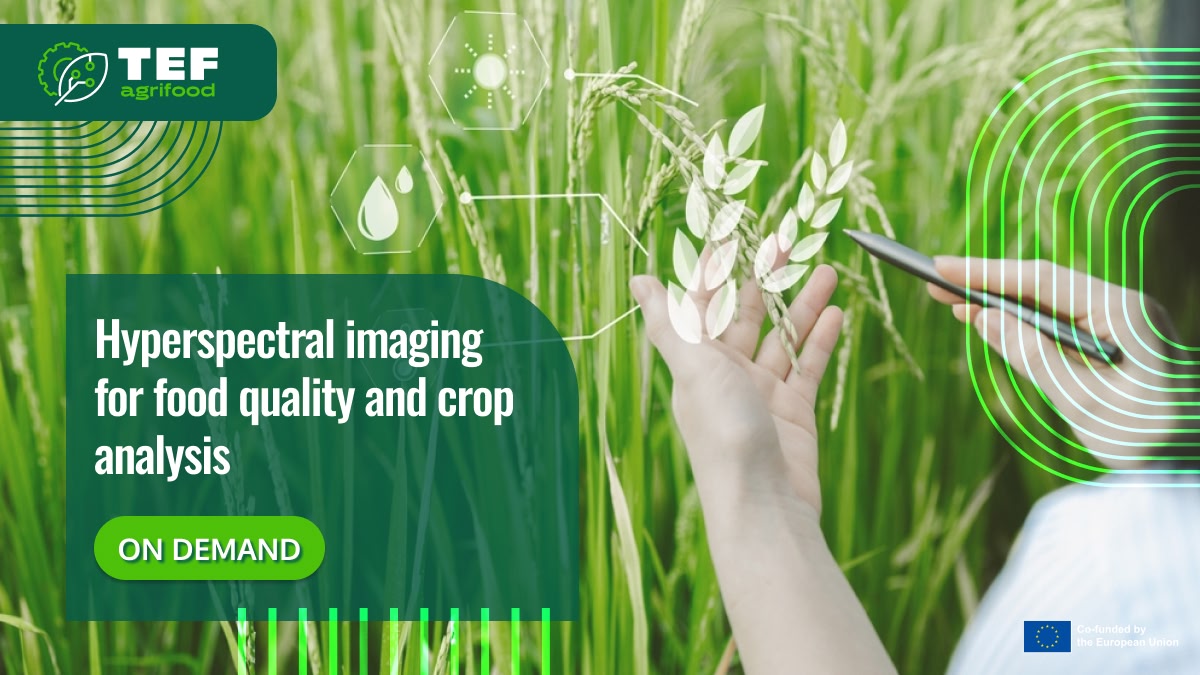
This on-demand training introduces participants to the working principles and applications of hyperspectral imaging in the agri-food domain. The course covers sensor types (linescan, snapshot), measurement setup, spectral interpretation, pre-processing techniques, and machine learning workflows for classification and regression.
Through practical examples from crops and food products (e.g., leek, potato, meat), participants learn how to set up measurements, process hyperspectral data, and evaluate models for real-world use cases.
If you want to get more information about the training, please get in touch with Marijke.hunninck@ilvo.vlaanderen.be
Learning objectives
By the end of the training, participants will be able to:
- Explain the working principles of hyperspectral sensors and imaging modalities.
- Set up a hyperspectral measurement campaign for agri-food applications.
- Pre-process and analyse hyperspectral data using basic machine learning techniques (PLSR, SVM).
- Interpret vegetation indices and spectral fingerprints relevant to plant and food quality.
- Evaluate the feasibility of implementing hyperspectral imaging in their own use cases.
Learning outcomes
Participants completing this training will be able to:
- Distinguish between linescan, snapshot and spectrally scanned hyperspectral systems.
- Apply spectral pre-processing operations such as masking and normalisation.
- Extract and analyse mean spectra for both classification and regression tasks.
- Use hyperspectral data to assess plant freshness, detect potato defects, or classify meat types.
- Identify limitations and potential of hyperspectral setups for laboratory or industrial environments.
Who should attend?
Researchers, quality-control specialists, crop and food analysts, data scientists, and professionals working with non-invasive sensing technologies in agri-food.
AI implementation
Data (data space / bigdata)
Other
Services
Software / AI model