
AI platforms and European testing infrastructure take centre stage at EIMA 2026
20 November 2026
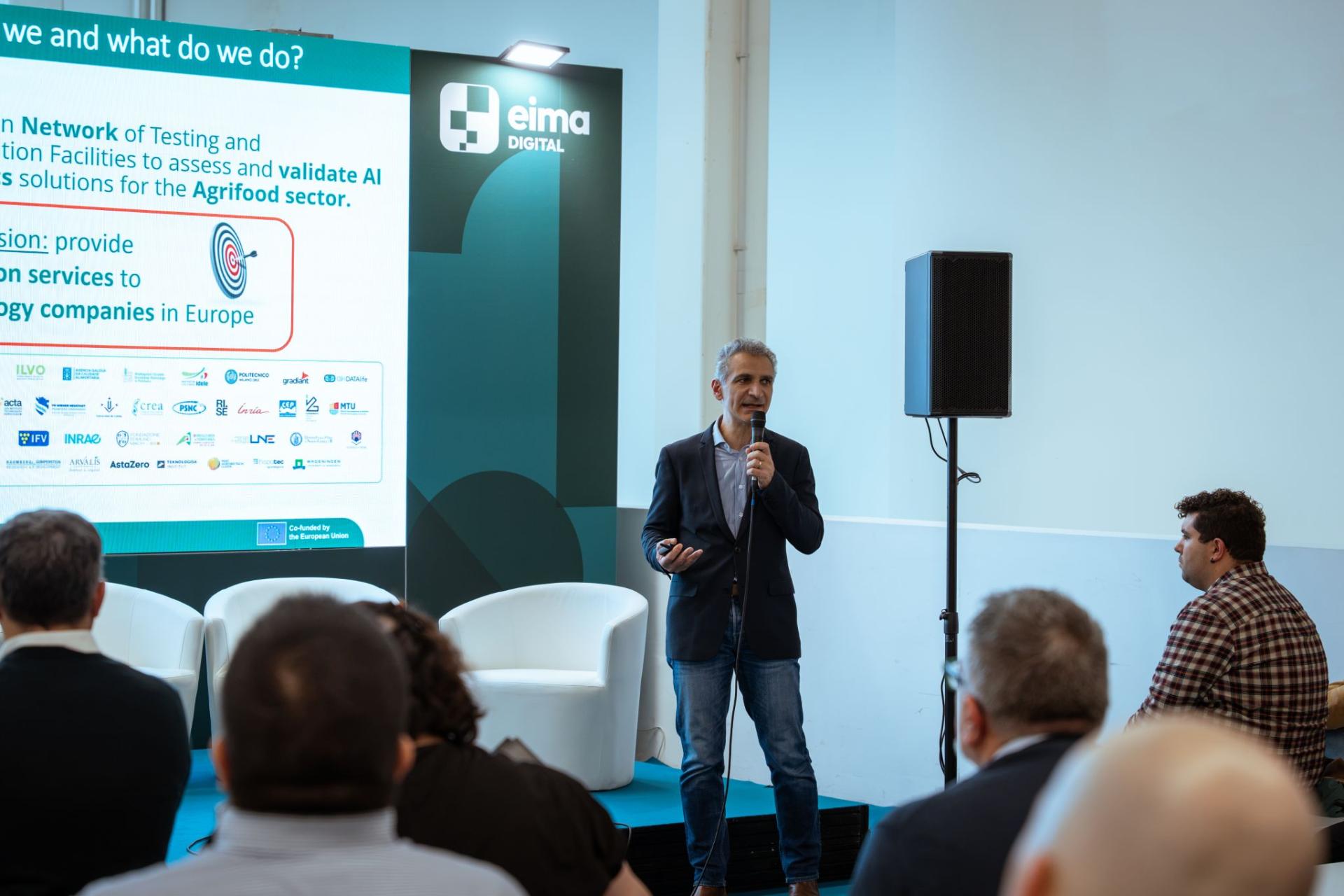
Drawing on two articles published in Chile and Spain, this news item looks at how Evja, IT4LIA AI Factory and agrifoodTEF were presented at EIMA 2026, from precision crop management to the validation of agricultural robotics.
Artificial intelligence and digital technologies took centre stage at EIMA 2026, the international agricultural machinery exhibition, and the event drew coverage from agricultural media beyond Italy. Chilean publication Reporte Agrícola focused on the solutions presented at the Digital Terrace, where Evja attracted attention as a precision agriculture platform designed to support real-time farm management and decision-making.
Evja is an agronomic intelligence platform that brings together crop nutrition, plant protection and irrigation management. It collects field data through wireless sensors and processes this information using artificial intelligence algorithms to generate predictive models. Farmers can access farm information and operational data from any device, including computers, tablets and smartphones, enabling them to plan agricultural interventions with greater precision.
The platform is the result of collaboration between young professionals in the agricultural sector, the CREA research centre, specialising in horticultural and ornamental crops, and the producer organisation San Lidano. This approach to open innovation brings together scientific expertise and practical production experience.
Making AI infrastructure more accessible
Alongside these developments, the IT4LIA AI Factory portal provides free access to advanced infrastructure and services, supporting the growth of the Italian and European artificial intelligence ecosystem.
As highlighted by Alessio Bolognesi, engineer at FederUnacoma’s Technical Department, in remarks reported by Reporte Agrícola, this represents a significant opportunity to access dedicated funding and resources at no cost – an opportunity whose full potential is not yet widely recognised by organisations.
The portal is aimed at researchers, public administrations, companies and start-ups. At European level, agrifoodTEF complements this landscape through a network of physical and digital facilities, known as nodes, where artificial intelligence and robotics solutions for agriculture can be tested and validated under real production conditions.
Testing and validating technologies in real-world conditions
Through the agrifoodTEF service catalogue, users can identify relevant services and contact partners within the Italian nodes according to their specific requirements. Services are tailored to define expected outcomes and identify the most suitable infrastructure, testing facilities, and technical, regulatory and business support.
Once the validation process is complete, users receive structured results, recommendations, detailed reports and an assessment of the market readiness of the tested solution.
By providing access to specialised facilities and expertise, this open innovation model helps European agricultural businesses shorten development timelines and reduce technological risks. Reporte Agrícola also notes that it offers valuable insights for the adoption of artificial intelligence in Latin America, particularly in Chile, where water efficiency and nutrient optimisation remain key challenges for fruit, vegetable and cereal production.
A second perspective from Spain
Spanish trade publication Interempresas also featured agrifoodTEF in its overview of the topics discussed at EIMA 2026. In its section on AI applied to agriculture, the article presents agrifoodTEF among the European initiatives that make it possible to assess and validate AI and robotics technologies in real working conditions, helping their uptake in the agri-food sector.
The same overview points to some of the barriers these technologies still face. Agricultural robotics is gaining ground in horticulture as a response to labour shortages, but initial costs, training needs and the lack of a specific regulatory framework continue to slow adoption. Data presented by the Agrofarma Observatory also show that precision agriculture covers 17% of the agricultural area considered in Italy, compared with a European average of 44%, with limited investment capacity and technical training among the main obstacles.
From agrifoodTEF’s perspective, these are the gaps that testing and experimentation facilities are designed to address, by giving technology providers access to real-world validation, regulatory guidance and evidence of market readiness before solutions reach farms.
Sources
This news item draws on the following articles:
- Reporte Agrícola, published on 10 November 2026.
- Interempresas, article by Ángel Pérez, published on 16 November 2026.