Overview
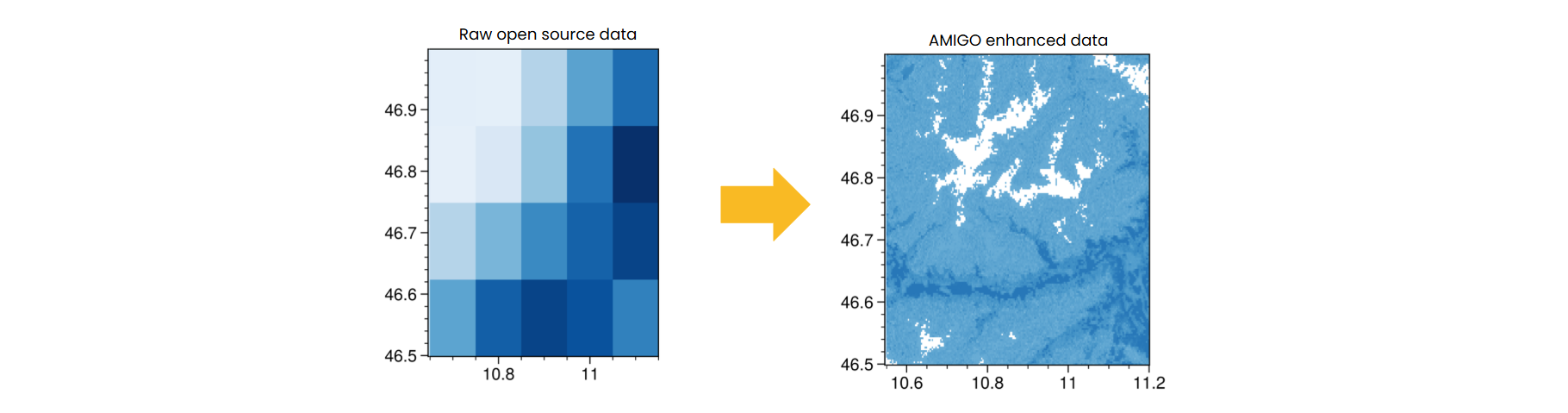
AMIGO S.r.l. is developing GEKO, a project aimed at developing an innovative, AI-based methodology for downscaling climate data, the process through which coarse-resolution climate information is translated into more detailed estimates at local scale.
To complement this activity, AMIGO received support from Fondazione Bruno Kessler (FBK), which provided two agrifoodTEF services: one aimed at creating a reliable observational dataset for the Trentino region, and the other dedicated to testing and evaluating downscaling approaches in local contexts.
Starting from a very concrete need for reliable historical data, the collaboration has produced a curated dataset built on the records of the Meteotrentino weather station network, complemented by a feasibility study of the machine learning approaches currently available in the field.
In the view of Flavia Trovalusci, AMIGO’s project manager, the significance of this work extends beyond the dataset itself. It has given the company a structured knowledge base on which the GEKO methodology can now be built, grounded from the outset in the most advanced technologies available.
 Italy
The challenge
GEKO aims to produce climate information at a resolution of a few hundred metres for mountain areas such as Trentino, where temperature, rainfall and wind can change sharply over short distances.
To learn these local patterns, and to verify that it has learned them correctly, a downscaling model needs long series of reliable local observations. Climate records collected in the field, however, are rarely ready for immediate use: before they can support model development, they need to be gathered, checked for consistency and organised around the variables that matter for the analysis.
For AMIGO, this was the starting point. As Flavia Trovalusci recounts "the collaboration started from the need to have a high-quality historical dataset", capable of providing a dependable foundation for the methodology the company intended to develop.
A second need ran in parallel. Machine learning applied to climate downscaling is a rapidly evolving area, and designing a new methodology required a clear and up-to-date understanding of existing approaches, of their strengths and of their limitations. Without such an overview, the risk would have been to build on assumptions rather than on a verified picture of the state of the art.
The agrifoodTEF service
AMIGO accessed two services provided by FBK, which coordinates agrifoodTEF:
- Provision of datasets - ID S00353: FBK collected and catalogued the observational data available in its archives and assessed their quality and completeness. It then selected the variables most relevant to the Trentino agricultural context and prepared them for use in downscaling models. The result is a dataset of Meteotrentino station observations from August 1985 to July 2025, covering temperature, precipitation, humidity, wind, solar radiation and atmospheric pressure. Each record retains the quality code assigned by Meteotrentino, so valid, estimated, interpolated and uncertain values remain distinguishable. The dataset was delivered with documentation on its sources, structure and known limitations.
- Testing the integration and performance of advanced weather forecasts - S00187: Building on FBK's expertise in meteorological modelling and AI-based downscaling, the second service focused on how downscaling models should be evaluated and improved for Trentino's climatic conditions. This included defining performance metrics, testing how observational data can be integrated into the models, assessing accuracy through cross-validation, and identifying possible optimisations.
See how FBK prepares datasets for your models
Need to test your forecasting or downscaling model? Explore the service

The impact
The collaboration translated these needs into concrete results. Historical data from the Meteotrentino weather stations were cleaned and processed, resulting in a consolidated dataset that includes the climate variables required by the project, among them temperature, precipitation, humidity and wind. Alongside the data work, "a feasibility study was also carried out on machine learning methodologies in this field," Trovalusci adds, "in order to provide an overview of the current state of the art in this sector”.
Taken together, these two strands gave AMIGO both the material and the methodological insight needed to move forward. The dataset provides a concrete basis for training and testing models, while the feasibility study helps steer the choice of techniques towards those best suited to the project's objectives.
For AMIGO, one of the most valuable aspects of the collaboration has been the opportunity to work alongside an established research organisation. "agrifoodTEF gave us the opportunity to work with Fondazione Bruno Kessler, a well-established and recognised institution in the Trentino region, and across Italy," Trovalusci points out.
She identifies two outcomes in particular. On the one hand, the collaboration enabled the company to build a knowledge base that reflects the current state of the art in AI-based climate downscaling. On the other, it established the groundwork on which GEKO is now being developed. In her words, it allowed the team "to lay the foundations for the project and for the methodology we want to develop, ensuring that it is based on the best technologies currently available."
AMIGO's experience highlights a role that agrifoodTEF is well placed to play in the early stages of innovation. By connecting companies with research institutions and with high-quality data sources, it allows new AI solutions to take shape on a verified scientific and technical basis, reducing uncertainty at the very moment when key methodological choices are made.
Visit AMIGO's website and watch the interview.